
ESAM supplies side channel blowers (also known as regenerative blowers) that can sometimes be confused with centrifugal blowers. Centrifugal blowers and side channel blowers are both types of mechanical equipment used to transport air or other gases. Yet, it is important to understand their similarities and key differences to choose the right equipment for your application.
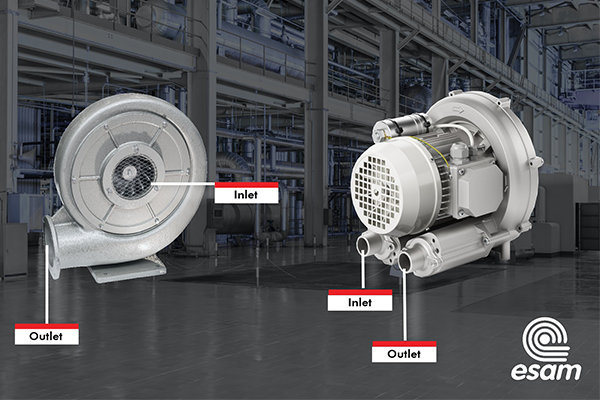
Both types of equipment move air using an impeller, in which air enters the inlet, travels with the impeller, and is exhausted at the outlet. Other than that, they are very different, starting from their configuration design.
The design of the blowers.
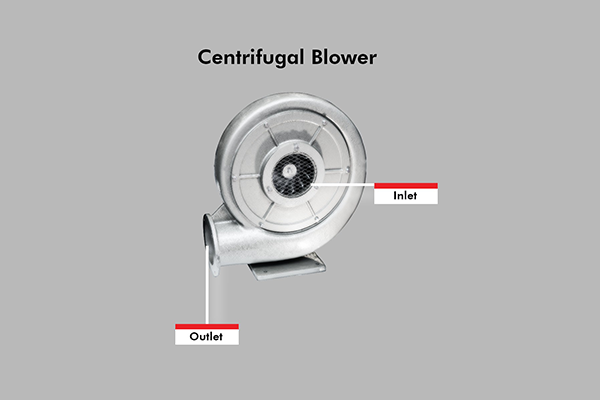
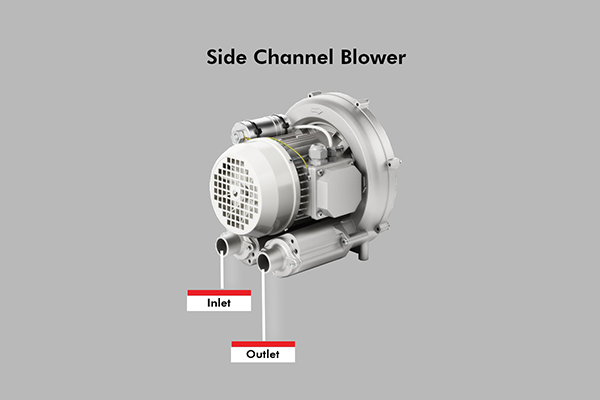
The differences in construction between a centrifugal and a side-channel blower make it easy to tell the two apart visually. A centrifugal blower is configured so that the inlet and outlet are perpendicular, with the inlet feeding air into the centre of the impeller and the outlet lateral to the impeller’s rotation. In a side-channel blower, the inlet and outlet are parallel, with both positioned perpendicular to the impeller’s rotation.
Centrifugal blowers.
As the name suggests, centrifugal blowers move air through centrifugal action. These blowers use a spinning impeller to generate airflow, drawing air into the centre of the impeller and forcing it outward by centrifugal force. Centrifugal blowers are commonly used in heating, ventilation, air conditioning (HVAC) systems and many industrial processes. They are typically more efficient at higher airflow rates and have relatively low pressure.
Side channel blowers.
Side channel blowers use rotating impellers to generate a pair of vortices, forcing the air to spiral and continuously compress it, building pressure from the moment it enters the inlet to the time it leaves the outlet. Side channel blowers are often used in applications where a low air volume must be moved at high pressure, such as pond aeration in aquaculture.
Best Applications.
Centrifugal Blowers – For applications where high flow at low pressures is required, HVAC, ovens, tunnels, filter flushing, gas boosting, dust control, air conveyor systems, fluid bed aerators, etc.
Side Channel Blowers – For applications requiring moderate flows at high pressure, including Aquatics (spas and pools), pond aeration, vacuum evacuation of gases and dust, packaging, drying processes in wine production, pneumatic conveying, sewage aeration, etc.
In summary, centrifugal blowers are considered low-pressure, high-flow blowers, while side channel blowers are high-pressure, low-flow blowers. These fundamental characteristics help dictate the types of applications to which they are suited. One of the great benefits of side-channel blowers is that they can operate as either pressure or vacuum blowers.